Sodium-Ion vs Lithium-Ion vs Solid-State EV Batteries: The Future of Electric Cars
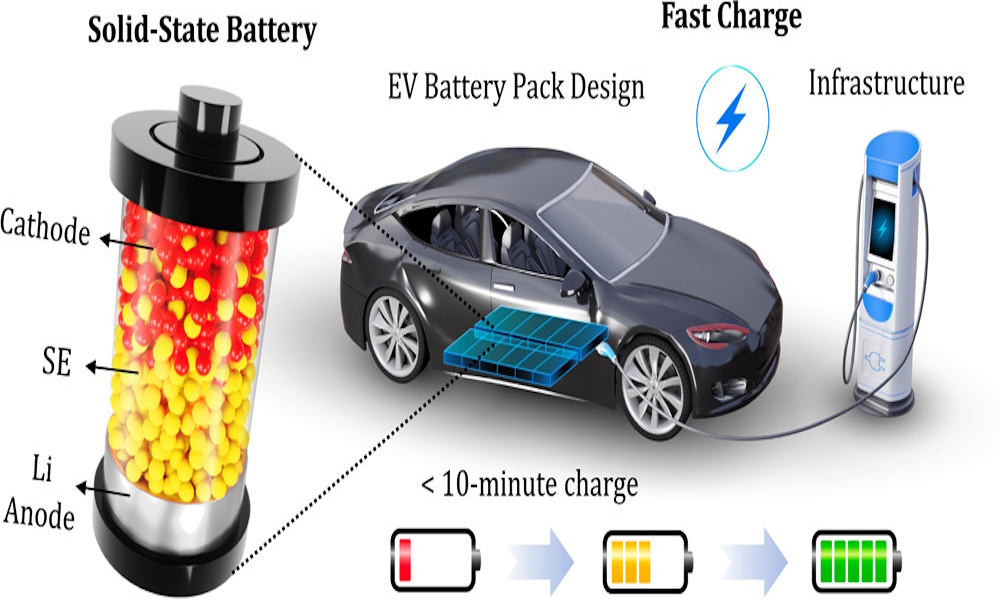
Table of Contents
- The Battery Revolution Changing Electric Vehicles Forever
- Understanding Lithium-Ion: The Current King of EV Batteries
- Sodium-Ion Batteries: The Affordable Game-Changer
- Solid-State Technology: The Ultimate Battery Dream
- Performance Comparison: Range, Charging, and Real-World Use
- Cost Analysis: Which Battery Wins Your Wallet?
- Safety and Environmental Impact: Beyond Just Performance
- The Future Timeline: When Will You Drive These Technologies?
- Frequently Asked Questions
The Battery Revolution Changing Electric Vehicles Forever
The morning air felt different when Sarah stepped into the dealership on that crisp January day in 2026, carrying with her a question that millions of potential electric vehicle buyers worldwide were asking themselves in increasingly desperate tones. Three years ago, she had watched her neighbor purchase a Tesla Model 3, marveling at its sleek design and instant acceleration, but the $45,000 price tag had seemed insurmountable for a middle school teacher’s salary. Now, standing before three distinctly different electric vehicles, each promising revolutionary battery technology, she realized the landscape had transformed in ways she couldn’t have imagined. The salesperson explained that one vehicle used traditional lithium-ion batteries, another featured the emerging sodium-ion technology everyone kept reading about in tech magazines, and the third, a limited-production model, showcased the mythical solid-state batteries that engineers had been chasing like alchemists seeking to turn lead into gold.
What Sarah didn’t know as she listened to the enthusiastic pitch was that her simple car-buying decision represented a pivotal moment in automotive history, where three radically different battery technologies were competing not just for market share but for the very future of sustainable transportation. The Department of Energy had invested over $50 million into sodium-ion research through the LENS consortium led by Argonne National Laboratory, recognizing that America’s electric vehicle future couldn’t rest solely on lithium supplies controlled by foreign nations. Meanwhile, researchers at Stanford University had just published breakthrough findings demonstrating that a nanoscale silver coating could solve the dendrite problem that had plagued solid-state battery development for decades, moving the technology from laboratory curiosity to near-commercial reality. The battery war wasn’t just about which technology could power a car from point A to point B anymore; it had evolved into a complex chess game involving geopolitics, environmental sustainability, manufacturing capabilities, and the fundamental question of whether ordinary people could afford the transition to electric transportation.
Before delving into the article, watch this video which highlights the revolution in the world of sodium batteries that surpasses lithium batteries:
The stakes couldn’t be higher, and the timeline for decisions couldn’t be more compressed. Environmental Protection Agency standards finalized in March 2024 require automakers to achieve fleet-average emissions of just 82 grams of CO2 per mile by 2032, representing a nearly 50% reduction from 2026 standards and effectively mandating that approximately 67% of new light-duty vehicles sold must be electric or plug-in hybrid. This regulatory pressure, combined with the Infrastructure Investment and Jobs Act’s $7.5 billion investment in charging infrastructure and battery manufacturing, has created a perfect storm of innovation where traditional lithium-ion dominance is being challenged by upstart technologies that promise cheaper costs, better safety, longer ranges, and reduced dependence on conflict minerals. Chinese battery giant CATL announced its Naxtra sodium-ion product line in 2025, claiming commercial-scale production was already underway, while Toyota committed to introducing solid-state batteries in production vehicles by 2027, a promise that sent shockwaves through an industry that had grown comfortable with incremental lithium-ion improvements.
Recognition of sodium-ion technology’s transformative potential extends beyond industry participants to respected technology analysts and research publications tracking innovation trends. MIT Technology Review breakthrough technologies for 2026 prominently featured sodium-ion batteries alongside commercial space stations and next-generation nuclear reactors, noting that this chemistry is “already sufficient for small passenger cars and logistics vehicles” with Chinese manufacturers like CATL and BYD leading commercialization while American companies and research institutions work to establish domestic production capabilities.
Understanding these three competing technologies isn’t just an academic exercise for engineers and policy wonks anymore. For consumers like Sarah standing in that dealership, the battery choice directly impacts purchase price, driving range, charging time, long-term ownership costs, resale value, and even whether the vehicle will still be technologically relevant five years after purchase. A sodium-ion battery vehicle might cost $8,000 less than its lithium-ion equivalent but offer 100 miles less range, perfect for city dwellers who rarely venture beyond suburban boundaries but inadequate for road trip enthusiasts. A solid-state battery vehicle promises 600-mile range and 10-minute charging but carries a premium price tag that could exceed $70,000, accessible only to early adopters with deep pockets and tolerance for first-generation product quirks. The lithium-ion vehicle sits comfortably in the middle, offering proven technology, reasonable range, and prices that have become almost mainstream, yet it carries the baggage of supply chain vulnerabilities and the nagging question of whether buying last year’s technology makes sense when revolution lurks just around the corner.
The transformation happening in battery technology extends far beyond the chemistry labs and manufacturing facilities where scientists obsess over electrode materials and electrolyte formulations. It represents nothing less than a fundamental reimagining of how we power our civilization’s most essential tool for personal mobility. For a century, gasoline engines defined automotive progress, their roar and rumble becoming the soundtrack of modern life, their complexity creating an entire ecosystem of mechanics, oil changes, and carbon monoxide that we accepted as simply the cost of movement. Now, in the span of less than a decade, we’re witnessing the potential obsolescence of that entire paradigm, replaced by silent motors powered by batteries that store electricity with ever-increasing density and decreasing cost. The question isn’t whether electric vehicles will dominate transportation anymore; that debate ended somewhere around 2023 when global EV sales crossed 10 million units annually and every major automaker committed to electrification timelines. The question now is which battery technology will win the race to power that electric future, and whether one technology will dominate or if we’ll see a diversified ecosystem where different chemistries serve different niches.
Sarah’s predicament mirrors the automotive industry’s larger dilemma in early 2026. Legacy automakers like Ford and General Motors have invested billions retooling factories for lithium-ion battery production, betting their corporate futures on a technology that emerged from Sony’s consumer electronics laboratories in the 1990s and was adapted for vehicles by Tesla in the mid-2000s. These investments can’t be easily abandoned if sodium-ion batteries suddenly capture 30% market share in the budget vehicle segment, nor can they be quickly pivoted if solid-state batteries achieve breakthrough cost reductions ahead of schedule. Meanwhile, Chinese manufacturers unburdened by such legacy commitments have moved aggressively into sodium-ion technology, with companies like HiNa Battery Technology and CATL already deploying the chemistry in electric scooters, delivery vehicles, and compact cars for the domestic Chinese market. The technological competition has morphed into industrial strategy, where battery choices reflect national priorities around resource independence, manufacturing capabilities, and strategic positioning for the post-carbon economy.
The human element in this battery revolution deserves attention equal to the technical specifications and cost projections that dominate industry conferences. Real people with real budgets need to make real decisions about expensive purchases that will affect their daily lives for years to come. A nurse driving 50 miles daily to a hospital shift needs different battery characteristics than a sales representative covering rural territories where charging infrastructure remains sparse. A rideshare driver accumulating 200 miles daily in urban traffic patterns evaluates batteries through a different lens than a weekend warrior seeking adventure vehicles for camping trips to national parks. The beauty and challenge of having three distinct battery technologies competing simultaneously is that it forces both consumers and manufacturers to grapple with the reality that one size doesn’t fit all in electric transportation, that different use cases genuinely demand different solutions, and that the future might be more heterogeneous and interesting than the monolithic gasoline-powered past we’re leaving behind.

Understanding Lithium-Ion: The Current King of EV Batteries
Lithium-ion battery technology didn’t begin its life destined for automotive greatness. In fact, when Sony commercialized the first lithium-ion batteries in 1991, they were designed to power portable video cameras, a consumer electronics niche that seems almost quaint by today’s standards. The fundamental principle that made lithium-ion batteries revolutionary then remains their core advantage now: lithium is the lightest metal on the periodic table and possesses electrochemical properties that allow it to store exceptional amounts of energy relative to its weight. When lithium ions shuttle back and forth between a cathode typically made of lithium cobalt oxide or lithium nickel manganese cobalt oxide and an anode usually constructed from graphite, they create an electrochemical potential that can be harnessed to power everything from smartphones to 5,000-pound electric SUVs.
The journey from laptop batteries to electric vehicle powertrains required solving problems that would have seemed insurmountable to those early Sony engineers. Scaling from a few dozen watt-hours in a laptop to 75-100 kilowatt-hours in a modern electric vehicle meant managing heat dissipation from thousands of individual cells, preventing thermal runaway that could cascade through an entire battery pack, ensuring mechanical stability during collisions, and achieving cycle lives exceeding 1,000 full charge-discharge cycles to provide reasonable vehicle longevity. Tesla’s contribution to lithium-ion battery development, often overlooked in discussions focused on their vehicles’ styling or autopilot features, was primarily in the realm of battery management systems that could monitor and control thousands of cylindrical cells simultaneously, extracting maximum performance while maintaining safety margins that satisfied regulators and insurance companies.
Current lithium-ion technology has evolved into several distinct chemistries, each with trade-offs that manufacturers select based on their specific vehicle positioning and target markets. High-nickel NMC cathodes, where nickel content reaches 80% or higher, deliver exceptional energy density enabling vehicles like the Tesla Model S to achieve ranges exceeding 400 miles on the EPA test cycle, but they’re more prone to thermal issues and require sophisticated cooling systems that add weight and cost. Lithium iron phosphate batteries, which CATL and BYD have championed particularly for the Chinese market, sacrifice some energy density but gain thermal stability, longer cycle life, and reduced costs by eliminating expensive cobalt and nickel, making them ideal for budget electric vehicles where 250-mile range suffices. The newest frontier involves incorporating silicon into graphite anodes, which can dramatically increase energy density since silicon can absorb far more lithium ions than graphite, though silicon’s tendency to swell during charging creates mechanical stress that degrades battery life unless carefully managed through nanostructuring techniques that researchers at Stanford and elsewhere have been perfecting.
Manufacturing lithium-ion batteries has become an industrial art form practiced at massive scale in gigafactories scattered across China, South Korea, Japan, and increasingly the United States and Europe. The process begins with mining lithium from salt flats in Chile and Argentina or hard rock deposits in Australia, followed by refining that dominantly occurs in China where approximately 80% of global lithium processing capacity resides despite the country producing less than 10% of raw lithium. Cathode materials are synthesized through high-temperature reactions combining lithium with nickel, manganese, and cobalt or with iron and phosphate, then coated onto aluminum foil collectors thinner than a human hair. Anodes receive similar treatment with graphite or silicon-graphite composites coated onto copper foil, with the entire assembly happening in ultra-dry environments where humidity can destroy materials that will later operate immersed in liquid electrolytes.
The liquid electrolyte that fills lithium-ion batteries deserves its own discussion because it represents both the technology’s greatest strength and its most significant vulnerability. These organic solvents containing lithium salts enable rapid ion transport between electrodes, facilitating the fast charging and high power delivery that make electric vehicles practical for modern life, but they’re also flammable and can decompose at elevated temperatures, potentially triggering the thermal runaway events that occasionally make headlines when electric vehicles catch fire after severe accidents. The solid electrolyte interphase that forms spontaneously on the anode during a battery’s first charge cycle acts as a protective barrier preventing further electrolyte decomposition, and recent research from the SLAC-Stanford Battery Center demonstrated that charging batteries with high current during this initial formation can improve the SEI layer’s quality, increasing battery lifespan by 50% while reducing formation time from 10 hours to just 20 minutes, a discovery with profound implications for manufacturing efficiency.
Performance characteristics of modern lithium-ion batteries have reached levels that seemed aspirational just five years ago. Energy density at the cell level for premium automotive batteries now exceeds 280 watt-hours per kilogram, with pack-level energy density approaching 180 watt-hours per kilogram after accounting for cooling systems, structural elements, and battery management electronics. This translates to real-world driving ranges of 300-400 miles for mid-size sedans and crossovers, sufficient for the vast majority of daily driving needs and even enabling road trips with strategic charging stops at the rapidly expanding network of DC fast chargers that can replenish 80% of battery capacity in 20-30 minutes. Cycle life has extended to where manufacturers comfortably offer 8-year or 100,000-mile battery warranties, with real-world data suggesting that batteries typically retain 80-90% of original capacity even after 150,000 miles of driving, making battery replacement concerns largely theoretical for most owners over typical vehicle ownership periods.
The lithium-ion supply chain’s geopolitical dimensions have become impossible to ignore as electric vehicle adoption accelerates toward the Environmental Protection Agency’s projected 67% market share by 2032. China’s dominance in battery manufacturing and critical mineral processing creates dependencies that make Western governments and automakers nervous, particularly as trade tensions escalate and the strategic importance of battery production becomes clearer. The Inflation Reduction Act’s $7,500 tax credit for electric vehicles now requires that battery components and critical minerals be sourced from the United States or its trading partners, explicitly designed to reduce Chinese supply chain reliance and incentivize domestic battery manufacturing. Companies like Ultium Cells, a joint venture between General Motors and LG Energy Solution, have broken ground on multiple gigafactories in Ohio, Tennessee, and Michigan, representing over $10 billion in investment aimed at localizing battery production and creating high-wage manufacturing jobs to replace those lost in the transition away from internal combustion engines.
Environmental considerations surrounding lithium-ion batteries extend beyond the tailpipe emissions they eliminate and into the complex territory of lifecycle analysis where mining impacts, energy-intensive manufacturing processes, and end-of-life recycling must all factor into honest assessments of environmental benefits. Lithium extraction from salt flats can consume vast quantities of water in arid regions where indigenous communities and fragile ecosystems compete for scarce resources, while hard rock mining generates its own environmental disturbances. Cobalt mining in the Democratic Republic of Congo has been documented as involving child labor and dangerous working conditions, spurring efforts to develop cobalt-free chemistries or at least ensure ethical sourcing through blockchain tracking and third-party certification. Recycling infrastructure remains nascent despite lithium-ion batteries being theoretically recyclable, with current economics favoring landfilling or repurposing used vehicle batteries for stationary storage rather than recovering valuable materials for new battery production, though this calculus may shift as material costs rise and recycling technologies improve.

Sodium-Ion Batteries: The Affordable Game-Changer
The promise of sodium-ion batteries rests on one elegantly simple fact that any high school chemistry student can appreciate: sodium is everywhere, abundant beyond scarcity concerns, and fundamentally cheap in ways that lithium can never be no matter how many new mines open or extraction technologies improve. Table salt, the sodium chloride sitting in kitchen cabinets worldwide, contains sodium that costs roughly 1% of lithium carbonate prices, and global sodium reserves exceed lithium by factors measured in thousands. This abundance translates directly into supply chain resilience and cost advantages that could democratize electric vehicle ownership for billions of people currently priced out of the lithium-ion premium market, particularly in developing nations where transportation electrification could leapfrog the gasoline infrastructure that Western countries spent a century building.
The Department of Energy recognized sodium-ion batteries’ strategic importance when it awarded $50 million over five years to establish the Low-cost Earth-abundant Na-ion Storage consortium, abbreviated as LENS, led by Argonne National Laboratory with participation from Brookhaven, Lawrence Berkeley, Pacific Northwest, Sandia, and SLAC national laboratories. This unprecedented federal commitment represents more than just financial support; it signals a fundamental shift in how the United States approaches energy storage independence and supply chain resilience. The comprehensive Department of Energy battery research programs extend beyond sodium-ion development to encompass advanced lithium-ion improvements, solid-state battery investigations, and grid-scale energy storage solutions that collectively aim to position America as a leader in the post-carbon economy. Understanding these government initiatives helps contextualize why certain battery technologies receive accelerated development timelines while others face slower commercialization paths.
This unprecedented federal investment reflects concerns about lithium supply chains dominated by Chinese processing and Australian mining, combined with the realization that achieving climate goals requires batteries cheap enough for mass adoption across all economic strata. Argonne Distinguished Fellow Christopher Johnson, who pioneered the lithium nickel-manganese-cobalt cathode chemistry that powers the Chevrolet Volt and Bolt, has turned his attention to developing sodium-ion cathodes with comparable performance, achieving driving ranges of 180-200 miles per charge in laboratory cells that could soon power production vehicles.
The transition from lithium-ion expertise to sodium-ion innovation at institutions like Argonne demonstrates how fundamental battery research builds upon decades of accumulated knowledge rather than starting from scratch with each new chemistry. Argonne National Laboratory battery research extends beyond cathode development to encompass comprehensive materials science investigations using advanced characterization techniques including high-energy X-ray scattering and electron microscopy that reveal atomic-scale processes occurring during charge and discharge cycles, knowledge that accelerates development timelines and prevents the trial-and-error approaches that plagued earlier battery technologies.
Sodium-ion batteries work through fundamentally similar principles to their lithium-ion cousins, with sodium ions shuttling between cathode and anode during charge and discharge cycles, but the chemistry differences introduce distinct characteristics that manufacturers must work around or turn into advantages depending on application. Sodium ions are roughly three times larger and heavier than lithium ions, which immediately suggests lower energy density since you’re moving more mass to store the same number of electrons, and indeed current sodium-ion batteries achieve energy densities of 140-160 watt-hours per kilogram at the cell level compared to 250-300 watt-hours per kilogram for advanced lithium-ion cells. This energy density gap translates directly into reduced driving range or increased battery pack size and weight, positioning sodium-ion technology primarily for applications where cost and sustainability matter more than maximum range, such as urban commuter vehicles, delivery fleets, and stationary grid storage.
The material advantages that sodium-ion batteries bring to the table extend beyond just elemental abundance and into genuine technical benefits that engineers find increasingly attractive. Sodium-ion batteries can use aluminum current collectors for both cathode and anode instead of requiring copper for the anode like lithium-ion batteries, and since aluminum costs less and weighs less than copper while offering better electrical conductivity, this represents meaningful cost and performance improvements. The Prussian blue and Prussian white cathode materials being explored for sodium-ion batteries contain no cobalt, nickel, or lithium, relying instead on iron, manganese, and sometimes vanadium combined with sodium, eliminating the ethical concerns around cobalt mining and the supply constraints around nickel and lithium that have caused price volatility in recent years. Perhaps most remarkably, sodium-ion batteries can be discharged to zero volts for safe shipping and long-term storage without suffering damage, whereas lithium-ion batteries degrade if stored fully discharged, giving sodium-ion significant logistics and safety advantages.
China has taken the lead in commercializing sodium-ion technology with a conviction and speed that exemplifies their industrial strategy approach to emerging technologies. CATL, the world’s largest battery manufacturer with roughly 37% global market share, launched its first-generation sodium-ion battery in 2021 and announced the Naxtra product line in 2025, claiming commercial-scale manufacturing was already underway at facilities in Fujian province. BYD, which manufactures both vehicles and batteries in integrated facilities giving them unusual flexibility, has built massive production capacity for sodium-ion batteries and reportedly plans to offer them as options in budget electric vehicles targeting markets in Southeast Asia, Africa, and Latin America where lower costs could accelerate adoption. The electric scooter manufacturer Yadea launched four models powered by sodium-ion batteries in Chinese cities during 2025, with Shenzhen piloting battery swapping stations specifically designed for sodium-ion two-wheelers serving delivery workers and commuters.
Performance characteristics of current-generation sodium-ion batteries position them as complementary to rather than replacing lithium-ion across the broader battery landscape. Energy density of 140-160 watt-hours per kilogram translates to approximately 100-120 watt-hours per kilogram at the pack level after accounting for structural elements and battery management systems, meaning a vehicle requiring a 60-kilowatt-hour pack to achieve 200 miles of range would need a battery weighing roughly 500-600 kilograms compared to 330-400 kilograms for an equivalent lithium-ion pack. This weight penalty matters more in performance vehicles where every kilogram affects acceleration and handling, but in urban delivery vans or economy cars where performance expectations align with practical needs, the trade-off becomes acceptable when balanced against 20-30% cost reductions. Charging speeds for sodium-ion batteries roughly match lithium iron phosphate systems, with 80% charge achievable in 30-40 minutes on appropriate DC fast charging infrastructure, adequate for vehicles that return to base daily for overnight charging.
Thermal stability represents one of sodium-ion batteries’ strongest selling points and could prove decisive in markets where safety concerns or extreme climate conditions dominate purchasing decisions. Sodium-ion batteries demonstrate superior thermal stability compared to high-nickel lithium-ion chemistries, with onset temperatures for thermal runaway typically exceeding 300 degrees Celsius versus 150-180 degrees Celsius for NMC lithium-ion batteries, providing significantly larger safety margins. This enhanced thermal stability allows for simplified cooling systems or even passive air cooling in some applications, reducing cost and complexity while improving reliability. Sandia National Laboratories has been investigating sodium-ion battery safety through its Battery Abuse Testing Lab, the Department of Energy’s core facility for battery safety research, performing tests to support science-based regulations and standards for this emerging technology.
The economic case for sodium-ion batteries rests not just on lower material costs but on the potential for entirely different manufacturing approaches that could further reduce production expenses. Since sodium-ion batteries can be manufactured using the same equipment and processes developed for lithium-ion production, existing gigafactories could add sodium-ion production lines with relatively modest capital investment, allowing manufacturers to hedge technology bets and respond to market demands flexibly. The elimination of copper current collectors and the ability to ship batteries fully discharged both contribute to cost savings that compound with raw material advantages, with industry analysts projecting that sodium-ion battery packs could achieve costs of $40-50 per kilowatt-hour by 2030 compared to $60-70 per kilowatt-hour for lithium iron phosphate and $80-100 per kilowatt-hour for high-nickel lithium-ion systems, a differential that could enable electric vehicles priced below $20,000 before subsidies.

Solid-State Technology: The Ultimate Battery Dream
Solid-state batteries have occupied a mythical status in battery development circles for decades, perpetually promising revolutionary improvements in safety, energy density, and charging speed while remaining frustratingly difficult to manufacture at commercial scale and reasonable cost. The core concept sounds deceptively simple: replace the flammable liquid electrolyte that fills conventional lithium-ion batteries with a solid ceramic, polymer, or composite material that conducts lithium ions between electrodes while eliminating fire risks and enabling the use of lithium metal anodes that could dramatically increase energy storage capacity. This simplicity masks extraordinary technical challenges around achieving adequate ionic conductivity in solid materials, maintaining physical contact between solid electrolyte and solid electrodes as they expand and contract during charging, and preventing the formation of dendrites that can penetrate solid electrolytes just as they plague liquid ones.
The dendrite problem that has bedeviled solid-state battery development for years may finally have met its match thanks to breakthrough research from Stanford University and MIT that independently identified solutions to this critical failure mode. Stanford researchers led by Professor X. Wendy Gu and Will Chueh discovered that applying an ultrathin silver coating to LLZO solid electrolyte surfaces, followed by heat treatment that diffuses silver ions into the material, makes the electrolyte five times more resistant to cracking while preventing lithium intrusion that causes dendrites. This breakthrough represents years of systematic investigation into the fundamental mechanics of how solid electrolytes fail under the stresses of repeated charging and discharging cycles. Stanford solid-state battery research combines cutting-edge materials science with advanced manufacturing techniques including atomic layer deposition and precision heat treatment protocols that could be scaled to industrial production, moving the technology from laboratory curiosity toward commercial viability in timelines measured in years rather than decades as previous solid-state efforts seemed to require Published in Nature Materials in January 2026, this research builds on their earlier work identifying how microscopic cracks form and propagate, providing not just a band-aid fix but fundamental understanding of the mechanics involved. Meanwhile, MIT Professor Yet-Ming Chiang’s team demonstrated that applying mechanical stress to solid electrolytes can control dendrite growth direction, keeping potentially harmful filaments parallel to electrodes rather than allowing them to bridge between electrodes and cause short circuits, opening pathways to engineering solutions like deliberately stress-inducing multilayer designs.
The convergence of mechanical engineering principles with electrochemistry represents an emerging frontier in battery development where traditional disciplinary boundaries dissolve in pursuit of solutions to complex failure modes. MIT Energy Initiative research encompasses not just fundamental science but also techno-economic analyses examining whether breakthrough technologies can achieve commercial viability, providing reality checks that prevent pursuing scientifically interesting but economically impractical pathways while identifying the most promising routes toward sustainable energy storage at the scales required for global decarbonization.
Material science at the heart of solid-state battery development involves choosing between three main categories of solid electrolytes, each with distinct advantages and limitations that shape their potential applications. Oxide electrolytes, including materials like LLZO, offer excellent chemical stability and compatibility with lithium metal anodes, but they’re brittle and require high-temperature sintering during manufacturing that complicates production and increases costs, with ionic conductivity typically lower than ideal. Sulfide electrolytes provide the highest ionic conductivity among solid electrolyte options, approaching or even exceeding that of liquid electrolytes in some cases, making them attractive for high-power applications, but they’re chemically unstable in air and can produce toxic hydrogen sulfide when exposed to moisture, creating manufacturing and safety challenges that must be addressed. Polymer electrolytes offer flexibility and ease of manufacturing, potentially enabling roll-to-roll production similar to film manufacturing, but they generally require elevated temperatures to achieve adequate conductivity and struggle with stability when paired with lithium metal anodes, limiting their practical applications.
Toyota’s commitment to introducing solid-state batteries in production vehicles by 2027 represents the most aggressive commercialization timeline from any major automaker, backed by an extensive patent portfolio exceeding 1,000 solid-state battery-related filings that gives them potential intellectual property advantages over competitors. Their approach reportedly focuses on sulfide electrolytes paired with lithium metal anodes targeting energy densities exceeding 400 watt-hours per kilogram at the cell level, potentially enabling electric vehicles with 600-mile ranges, though initial production will likely be limited to premium models at prices reflecting first-generation manufacturing costs. Nissan has similarly announced intentions to introduce solid-state battery vehicles by 2028, emphasizing manufacturing process innovations they’ve developed to address the interfacial contact problems that have plagued earlier solid-state prototypes, while Volkswagen through its investment in QuantumScape has supported development of ceramic separator technology that the startup claims solves key technical hurdles.
Startup companies pursuing solid-state battery commercialization represent billions in venture capital investment and thousands of hours of research aimed at capturing what many view as the ultimate battery prize. QuantumScape, which went public through a SPAC merger and counts Volkswagen as a major investor and customer, claims its ceramic separator technology enables lithium metal anodes to be paired with conventional cathode materials, achieving energy densities 80% higher than current lithium-ion batteries while allowing 80% charges in 15 minutes without degradation. Solid Power, backed by BMW and Ford, pursues a different architecture using sulfide solid electrolytes with silicon anodes, targeting a more conservative timeline but potentially easier manufacturing pathway. Factorial Energy has attracted investments from Mercedes-Benz and Stellantis for its quasi-solid-state approach using a proprietary electrolyte that combines solid and gel-like properties, claiming it can integrate into existing lithium-ion manufacturing processes with minimal retooling, dramatically reducing commercialization barriers.
The manufacturing challenge that separates laboratory solid-state battery cells from commercial production at gigawatt-hour scale involves far more than simply scaling up processes that work with individual cells. Maintaining intimate physical contact between solid electrolyte and solid electrode materials across square meters of surface area as batteries charge and discharge thousands of times, causing expansion and contraction that can create voids and increase resistance, requires either materials that perfectly match thermal expansion coefficients or manufacturing approaches that maintain pressure or create compliant interfaces that accommodate movement. High-temperature processing required for oxide electrolytes conflicts with temperature-sensitive cathode materials, necessitating sequential assembly approaches that complicate manufacturing and introduce additional interfacial challenges. The solid-state battery materials market, valued at $1.15 billion in 2025, is projected to reach $4.03 billion by 2030 according to recent industry analysis, reflecting the capital-intensive nature of establishing production capabilities and the premium prices early solid-state products will command.
Performance projections for solid-state batteries when they eventually reach commercial production paint a compelling picture of what next-generation electric vehicles might deliver. Energy densities exceeding 400 watt-hours per kilogram at the cell level could translate to 300 watt-hours per kilogram at the pack level, enabling electric sedans with 600-800 mile ranges or reducing battery pack size and weight by 40-50% for vehicles maintaining current 300-mile ranges, dramatically improving efficiency and performance. Fast charging capabilities unconstrained by thermal runaway risks that limit current lithium-ion batteries could enable 80% charges in 10-15 minutes without compromising cycle life, making electric vehicles functionally equivalent to gasoline vehicles in refueling convenience. Cycle life estimates suggest solid-state batteries could maintain 80% capacity after 3,000-5,000 full charge-discharge cycles, translating to 1.5-2 million miles of driving in typical use patterns, effectively making batteries outlast the vehicles they power and eliminating replacement concerns entirely.

Performance Comparison: Range, Charging, and Real-World Use
The theoretical specifications that battery manufacturers tout in press releases and technical papers matter less than real-world performance that drivers experience on daily commutes, long road trips, and in extreme weather conditions that test battery systems beyond controlled laboratory environments. A lithium-ion battery rated for 300 miles of EPA-cycle range might deliver 350 miles on a mild spring day driving at steady highway speeds but only 180 miles during winter cold snaps with the heater running continuously or summer heat waves requiring air conditioning, while aggressive driving with frequent acceleration and high speeds can reduce range by 30-40% compared to conservative driving. Sodium-ion batteries, with their superior thermal stability but lower energy density, might show less range degradation in temperature extremes but start from a lower baseline, making the comparison more complex than simple spec-sheet numbers suggest.
Charging infrastructure compatibility and charging speed limitations vary significantly across battery chemistries and represent practical considerations that affect ownership experience more than buyers typically anticipate before purchase. Optimizing the charging experience requires investing in quality cables and adapters that can handle high power levels safely while maintaining flexibility in cold weather when cheaper alternatives become stiff and difficult to manage. Premium charging cables designed specifically for electric vehicles incorporate temperature monitoring, reinforced strain relief at connection points, and weather-resistant materials that withstand years of outdoor use at public charging stations where equipment often endures harsh conditions without the protection of garage storage. Current lithium-ion batteries can leverage the full capabilities of 150-350 kilowatt DC fast chargers that the Infrastructure Investment and Jobs Act’s $7.5 billion investment is deploying across America, achieving 20-30 minute charge times for 10-80% state of charge, though tapering occurs above 80% as battery management systems slow charging to protect cell longevity. Sodium-ion batteries generally charge at rates comparable to lithium iron phosphate systems, typically supporting 100-150 kilowatt charging that delivers 80% charge in 30-40 minutes, adequate for most uses but noticeably slower than the fastest lithium-ion options. Solid-state batteries promise to revolutionize fast charging by eliminating thermal constraints, potentially supporting 350+ kilowatt charging throughout most of the charge cycle, but this remains theoretical until commercial products emerge.
Shop on AliExpress via link: wholesale-electric-car-charging-cable
Temperature performance represents a critical real-world consideration that goes beyond abstract specifications and directly impacts whether batteries function adequately in the diverse climate conditions where vehicles must operate year-round. Lithium-ion batteries suffer significant capacity loss in cold weather as reduced temperature slows chemical reactions and increases internal resistance, with typical range reductions of 20-40% in temperatures below freezing, requiring sophisticated thermal management systems that can precondition batteries before charging and maintain optimal operating temperatures during driving. Recent research from Stanford has documented how storing lithium-ion batteries at sub-freezing temperatures can crack cathodes and separate them from other battery components, emphasizing the importance of temperature management for long-term durability. Sodium-ion batteries demonstrate less temperature sensitivity in some respects due to their chemical stability, maintaining functionality across wider temperature ranges without the same degradation patterns, though their lower base energy density means cold-weather range reductions still impact practical usability.
Driving range comparisons between battery technologies must account for vehicle efficiency differences that can be as important as battery capacity in determining actual miles traveled per charge. Beyond simple EPA range ratings, prospective buyers should examine how different electric vehicles compare in real-world conditions including highway driving at 70 mph, cold weather performance with heating systems active, and cargo loading scenarios that increase weight and aerodynamic drag. Direct comparisons between competing models using identical battery capacities reveal that engineering excellence in motor efficiency, regenerative braking calibration, and aerodynamic design can produce 20-30% range variations independent of battery chemistry, making vehicle selection as important as battery technology when optimizing for specific driving patterns and priorities. A compact sodium-ion powered urban vehicle weighing 2,800 pounds and offering 40-kilowatt-hour battery capacity might achieve 180-200 miles of range through aerodynamic design and efficient motors, while a less efficient vehicle with the same battery might manage only 140-160 miles. Current lithium-ion powered electric vehicles span enormous range capabilities from the Mercedes EQS achieving over 450 miles with its 107.8-kilowatt-hour battery to budget options like the Nissan Leaf offering 149 miles from its 40-kilowatt-hour pack, demonstrating that battery chemistry alone doesn’t determine range outcomes. Solid-state batteries’ projected energy density advantages could enable 600-800 mile ranges in efficiently designed vehicles, eliminating range anxiety entirely and making electric vehicles superior to gasoline equivalents in this dimension.
The degradation patterns that batteries exhibit over thousands of charge-discharge cycles significantly affect long-term ownership costs and vehicle resale values, making cycle life a more important specification than many buyers realize when focused on initial purchase price and range. Premium lithium-ion batteries in current Tesla vehicles demonstrate remarkably slow degradation, typically retaining 90% capacity after 150,000 miles of driving and 85% capacity at 200,000 miles, suggesting that batteries will outlast many other vehicle components and making replacement unlikely during typical ownership periods. Budget lithium-ion chemistries like lithium iron phosphate trade some energy density for enhanced cycle life, potentially maintaining 80% capacity through 3,000-4,000 full cycles compared to 1,000-1,500 cycles for high-nickel chemistries, making them ideal for commercial applications like taxis and delivery vehicles that accumulate mileage rapidly. Sodium-ion batteries are demonstrating cycle lives comparable to lithium iron phosphate in laboratory testing, with researchers at Argonne National Laboratory achieving cells that match lithium-ion performance in charge-discharge cycling, suggesting durability won’t limit sodium-ion adoption once energy density and cost targets are met.
Performance in real-world use cases beyond the standardized EPA test cycle reveals how different battery technologies suit different driver profiles and usage patterns better than abstract specifications suggest. Urban delivery drivers accumulating 150-200 miles daily in stop-and-go traffic where regenerative braking recovers energy and speeds rarely exceed 45 mph represent ideal candidates for sodium-ion batteries, where lower cost and adequate range matter more than maximum highway performance. Long-distance commuters driving 100+ miles daily at highway speeds prioritizing range and fast charging would benefit most from advanced lithium-ion or future solid-state batteries offering 300+ mile ranges and 20-minute charge capabilities. Weekend-only drivers covering perhaps 50 miles weekly could prosper with any battery technology since even modest ranges suffice and charging happens infrequently at home overnight, making purchase price the dominant consideration.

Cost Analysis: Which Battery Wins Your Wallet?
The total cost of ownership for electric vehicles powered by different battery technologies extends far beyond sticker prices and requires careful analysis of purchase costs, charging expenses, maintenance requirements, insurance rates, resale values, and potential battery replacement costs over typical ownership periods. Understanding the true economics of electric vehicle ownership requires examining costs that mainstream automotive reviews often overlook or minimize in their enthusiasm for promoting electrification. Many buyers focus exclusively on purchase price differentials and projected fuel savings while neglecting insurance premiums that can run 15-20% higher for electric vehicles, home electrical upgrades required for Level 2 charging that might cost $1,200-2,500 depending on panel capacity and circuit availability, and depreciation patterns that currently favor certain battery chemistries over others based on consumer perceptions about longevity and obsolescence risk. Current lithium-ion powered electric vehicles carry purchase prices ranging from $28,000 for budget options like the Chevrolet Bolt EUV to over $100,000 for luxury performance vehicles, with battery packs typically representing 30-40% of total vehicle cost at approximately $130-150 per kilowatt-hour including pack assembly and integration. Sodium-ion vehicles when they arrive commercially could undercut lithium-ion equivalents by $5,000-8,000 primarily through battery cost savings, potentially enabling electric vehicles priced below $25,000 before tax credits, bringing them into price parity with gasoline vehicles and dramatically expanding addressable markets.
Battery pack costs have declined precipitously over the past decade through manufacturing scale improvements, supply chain optimization, and incremental chemistry advances, falling from approximately $1,100 per kilowatt-hour in 2010 to $130-150 per kilowatt-hour in 2026 for lithium-ion systems, representing an 85-90% cost reduction that made electric vehicles commercially viable. Industry projections suggest lithium-ion costs could reach $80-100 per kilowatt-hour by 2030 as manufacturing continues scaling and next-generation chemistries incorporating silicon anodes and high-nickel cathodes become standard, potentially dropping further to $60-70 per kilowatt-hour by 2035. These cost projections rely on comprehensive techno-economic models that account for raw material prices, manufacturing learning curves, economies of scale, and technological improvements across the entire battery supply chain. Detailed sodium-ion battery cost projections published in peer-reviewed energy journals suggest that this emerging chemistry could achieve cost parity with lithium iron phosphate by 2026 and undercut it by 20-30% by 2030, potentially enabling electric vehicles priced competitively with gasoline equivalents without requiring government subsidies to bridge the affordability gap. Sodium-ion batteries could accelerate this cost reduction timeline, with Chinese manufacturers claiming they’ve already achieved cost parity with lithium iron phosphate batteries around $75-85 per kilowatt-hour at the pack level, and projections suggesting $40-50 per kilowatt-hour is achievable by 2030 once manufacturing scales beyond current pilot production volumes.
Solid-state battery costs remain highly speculative since no commercial production exists beyond small-scale pilot lines and prototype cells that tell us little about eventual manufacturing costs at gigawatt-hour scale. QuantumScape has suggested their cells could achieve cost parity with advanced lithium-ion batteries once manufacturing scales sufficiently, though they acknowledge initial production will carry significant premiums reflecting development costs and limited volume, potentially exceeding $300-400 per kilowatt-hour for first-generation products. Toyota’s manufacturing expertise and vertical integration might enable more aggressive solid-state battery pricing than smaller startups can achieve, though they’ve acknowledged that initial vehicles will be low-volume premium products where higher costs can be absorbed, suggesting $200-250 per kilowatt-hour might be realistic for their 2027-2028 introduction. Analysts project that solid-state batteries could reach $100-120 per kilowatt-hour by the mid-2030s if technical and manufacturing challenges are successfully resolved, potentially undercutting advanced lithium-ion through superior performance that allows smaller packs to achieve equivalent or better range.
Charging cost comparisons between home charging, public Level 2 charging, and DC fast charging reveal that fuel costs for electric vehicles vary enormously depending on charging behavior and local electricity rates, making generalized comparisons difficult but directionally illuminating. Home charging at typical residential electricity rates of $0.12-0.15 per kilowatt-hour costs approximately $3-5 for 100 miles of driving, dramatically cheaper than gasoline at $3-4 per gallon delivering perhaps 30 miles per gallon in equivalent vehicles, creating fuel cost savings of $800-1,200 annually for drivers covering 12,000 miles. However, achieving these attractive home charging economics requires proper electrical infrastructure that many existing homes lack, particularly older properties built before electric vehicles were contemplated and equipped with 100-amp or 150-amp electrical panels insufficient for simultaneously powering air conditioning, electric dryers, and 40-amp vehicle charging circuits. Common mistakes during installation can compromise safety, violate electrical codes, void vehicle warranties, or simply fail to deliver the charging speeds that buyers expect, making it crucial to understand proper specifications and hiring qualified electricians familiar with National Electrical Code requirements for electric vehicle supply equipment. Public DC fast charging stations typically charge $0.35-0.55 per kilowatt-hour or time-based fees that often exceed these rates, increasing costs to $10-15 for 100 miles, still cheaper than gasoline but eroding the economic advantage significantly. The battery chemistry powering vehicles doesn’t directly affect charging costs since electricity prices are independent of battery technology, though sodium-ion batteries’ slightly lower efficiency might increase consumption by 5-10% compared to optimized lithium-ion systems.
Maintenance cost advantages that electric vehicles enjoy over gasoline equivalents through elimination of oil changes, transmission services, spark plug replacements, and exhaust system repairs apply equally across battery technologies, creating a common $400-600 annual savings compared to gasoline vehicles that slightly favors electric ownership regardless of underlying battery chemistry. While electric vehicles eliminate traditional maintenance requirements, they introduce new considerations around battery health monitoring and thermal management system maintenance that diligent owners should address to maximize longevity. Digital battery testers and voltage monitors designed for high-voltage electric vehicle battery packs enable proactive identification of cell imbalances or degradation patterns before they affect driving range, while coolant system maintenance tools help ensure thermal management operates optimally to prevent the overheating that accelerates battery aging in climates with extended summer heat. Tire wear patterns may differ slightly between sodium-ion and lithium-ion vehicles due to weight differences, with heavier sodium-ion battery packs potentially accelerating tire replacement by 10-15%, though this represents perhaps $100-200 additional cost spread over several years. Brake maintenance costs are negligible for all electric vehicles since regenerative braking handles most deceleration, dramatically extending traditional brake pad life to 100,000 miles or more compared to 30,000-50,000 miles in gasoline vehicles, creating another maintenance advantage independent of battery technology.
Shop on AliExpress via link: wholesale-battery-tester-automotive
Insurance costs for electric vehicles have become increasingly competitive with gasoline equivalents as insurers gain experience with repair costs and safety performance, though battery damage claims from accidents create uncertainties that some insurers price conservatively, particularly for expensive vehicles where battery replacement might approach $15,000-20,000. Sodium-ion batteries’ enhanced safety characteristics and potentially lower replacement costs might eventually earn insurance discounts compared to lithium-ion vehicles, though this market is too immature for pricing signals to have emerged. The National Highway Traffic Safety Administration’s Battery Safety Initiative is collecting data on electric vehicle crashes and battery-related incidents to inform science-based regulations and standards, work that will eventually provide insurers with actuarial data to price policies accurately based on actual rather than perceived risks across different battery technologies.
Resale values represent the most speculative element of total ownership cost analysis since the used electric vehicle market remains relatively immature and battery technology evolution creates obsolescence concerns that affect buyer willingness to purchase aging electric vehicles. Current lithium-ion vehicles are experiencing steeper depreciation than gasoline equivalents in some segments, reflecting buyer concerns about battery degradation and range anxiety about used vehicles with reduced capacity, though some models like Tesla vehicles hold value remarkably well. Sodium-ion vehicles might experience different depreciation patterns if their lower initial costs create different buyer expectations, though this seems highly uncertain. Solid-state battery vehicles’ projected superior longevity and performance could enable them to hold value better than current lithium-ion vehicles, though premium initial prices might offset this advantage.
Safety and Environmental Impact: Beyond Just Performance
Battery safety encompasses far more than just fire risk and thermal runaway prevention, extending into crash safety, electrical hazard protection, manufacturing safety, transportation safety, and end-of-life handling safety that collectively determine whether battery technologies can be deployed responsibly at the scales required for transportation electrification. The National Highway Traffic Safety Administration has established comprehensive Battery Safety Initiative for Electric Vehicles coordinating research and activities to address safety risks relating to electric vehicle batteries, conducting special investigations of crash and non-crash events, researching battery diagnostics and prognostics for early failure detection, examining battery management system cybersecurity, and participating in development of Global Technical Regulation No. 20 for Electric Vehicle Safety that includes battery fire safety requirements. Battery safety transcends engineering challenges to become a critical factor in consumer confidence and insurance industry willingness to support electric vehicle adoption at scale. The NHTSA electric vehicle safety programs encompass not just post-crash fire prevention but also examine high-voltage battery charging failure modes, battery management system cybersecurity vulnerabilities that could enable remote attacks, and development of standardized emergency response protocols that ensure first responders can safely handle accidents involving vehicles with 400-800 volt electrical systems containing enough stored energy to power typical homes for several days. The Federal Motor Vehicle Safety Standard 305a that NHTSA finalized includes performance and risk mitigation requirements for propulsion batteries, post-crash electrical shock protection through multiple compliance options, fire safety requirements prohibiting fire or explosion for one hour post-crash, and mandates that manufacturers provide emergency response guides to first responders detailing battery fire risks and extinguishing procedures.
Thermal runaway events that can occur in lithium-ion batteries when cells overheat due to internal short circuits, external damage, or manufacturing defects represent the most dramatic safety concern that shapes public perception of electric vehicle safety despite statistical evidence suggesting electric vehicles catch fire less frequently than gasoline vehicles. When thermal runaway occurs, it can propagate through a battery pack as one failing cell heats adjacent cells above their thermal runaway threshold, creating cascading failures that generate intense heat, toxic gases, and potential explosions if gases ignite, a process that can continue for hours even after the initial fire is extinguished. Lithium iron phosphate batteries demonstrate significantly better thermal stability than high-nickel chemistries, with thermal runaway onset temperatures around 250-270 degrees Celsius versus 150-180 degrees Celsius for NMC batteries, providing much larger safety margins. Sodium-ion batteries offer thermal stability exceeding even lithium iron phosphate, with onset temperatures above 300 degrees Celsius and inherently less energy release during thermal runaway due to their chemical composition, potentially enabling simplified battery pack designs with reduced cooling requirements and fire suppression systems.
Solid-state batteries’ elimination of flammable liquid electrolytes represents their most compelling safety advantage, theoretically removing the primary fuel source for battery fires and dramatically reducing thermal runaway risks that plague conventional lithium-ion designs. The ceramic, polymer, or composite solid electrolytes being developed for solid-state batteries simply cannot catch fire in the way that organic liquid electrolytes do, and even if cells overheat due to electrical shorts or external damage, the failure modes are fundamentally different and potentially far less dangerous. However, solid-state batteries are not without safety concerns; lithium metal anodes that enable their high energy density present their own risks if dendrites form and cause internal shorts, and the manufacturing processes involving high temperatures and reactive materials create workplace safety challenges that must be addressed. Research from Stanford and MIT on preventing dendrite formation through protective coatings and mechanical stress management aims to eliminate these failure modes before solid-state batteries reach commercial production, ensuring that their theoretical safety advantages translate into practical reality.
Environmental impact analysis of battery production extends far beyond mining and processing to encompass manufacturing energy consumption, chemical waste generation, water usage, and the carbon footprint embedded in batteries before they ever power a vehicle mile. Manufacturing lithium-ion batteries is energy-intensive, with estimates suggesting 50-75 kilowatt-hours of energy consumed per kilowatt-hour of battery capacity produced, and if that energy comes from coal-fired power plants, the carbon debt can take 30,000-50,000 miles of driving to overcome compared to continuing to drive an existing gasoline vehicle, though this calculation improves dramatically when manufacturing uses renewable energy. The mining operations that extract lithium, cobalt, nickel, and graphite all carry environmental costs through habitat disruption, water contamination risks, and the carbon emissions from heavy machinery and ore processing, with lithium extraction from South American salt flats consuming approximately 500,000 gallons of water per ton of lithium produced in regions where water scarcity affects indigenous communities and ecosystems.
Cobalt mining’s ethical and environmental dimensions have received particular scrutiny following investigations documenting child labor and dangerous working conditions in artisanal mines in the Democratic Republic of Congo, which produces approximately 70% of global cobalt supply, spurring battery manufacturers to pursue cobalt-free chemistries or implement supply chain transparency measures like blockchain tracking and third-party audits. Sodium-ion batteries completely eliminate cobalt from their material requirements and avoid nickel as well, dramatically reducing ethical concerns and environmental impacts associated with these materials. The elimination of lithium from sodium-ion batteries similarly reduces mining impacts and supply chain vulnerabilities, though the sodium used in batteries must still be refined to high purity levels requiring energy input, just at dramatically lower cost and environmental impact than lithium processing.
Recycling infrastructure for lithium-ion batteries remains nascent despite the technology being theoretically recyclable, with current economics often favoring repurposing degraded electric vehicle batteries for stationary energy storage rather than recovering materials for new battery production. Direct cathode recycling processes that can recover and reconstitute cathode materials without breaking them down to elemental components could improve recycling economics and environmental benefits compared to pyrometallurgical smelting that requires extreme temperatures and can only recover certain metals. The Environmental Protection Agency has allocated funding through the Infrastructure Investment and Jobs Act to develop battery collection best practices and battery labeling guidelines by September 2026, recognizing that improving recycling rates requires addressing collection challenges, transportation safety, and communication across the battery lifecycle from manufacturers to consumers to recyclers.
Life cycle analysis comparing electric vehicles powered by different battery chemistries must account for manufacturing impacts, use phase emissions based on electricity grid carbon intensity, and end-of-life recycling or disposal to provide honest assessments of environmental benefits. Studies consistently show that even when accounting for manufacturing emissions and current grid mixes, electric vehicles generate lower lifetime carbon emissions than comparable gasoline vehicles, with the advantage growing as electricity grids incorporate more renewable generation. Sodium-ion batteries’ lower manufacturing energy requirements and elimination of conflict minerals could improve their lifecycle environmental profile compared to lithium-ion despite comparable use-phase emissions. Solid-state batteries’ longer projected lifespans could spread manufacturing impacts across more vehicle miles, potentially offering the best lifecycle outcomes if their performance projections are realized, though manufacturing energy requirements for solid electrolytes remain uncertain at commercial scale.

The Future Timeline: When Will You Drive These Technologies?
The automotive industry’s transformation toward battery electric vehicles is proceeding along multiple parallel timelines as lithium-ion technology continues improving incrementally, sodium-ion technology transitions from laboratory demonstrations to commercial production, and solid-state technology pursues breakthrough performance improvements while solving manufacturing challenges. For consumers trying to time vehicle purchases to capture the right balance of technology maturity, price reasonableness, and features that matter for their specific needs, understanding these timelines helps inform decisions about whether to buy now with current technology, wait for next-generation improvements arriving in two to three years, or hold off for revolutionary solid-state vehicles potentially arriving in five to seven years.
Lithium-ion technology’s roadmap through 2030 involves continued incremental improvements rather than revolutionary changes, with manufacturers focusing on increasing energy density through silicon anode incorporation, optimizing cathode formulations to reduce cobalt and nickel while maintaining performance, improving manufacturing efficiency to drive down costs, and extending cycle life through better electrolyte formulations and battery management systems. Current lithium-ion vehicles offering 300-mile ranges and 30-minute fast charging will give way to models achieving 400-mile ranges and 20-minute fast charging by 2028-2029 as silicon anodes and improved cathodes become standard, while costs could drop below $100 per kilowatt-hour at the pack level, enabling electric vehicles priced competitively with gasoline equivalents before incentives. The Inflation Reduction Act’s $7,500 tax credit for electric vehicles meeting domestic content requirements provides additional incentive for manufacturers to accelerate lithium-ion production in North American facilities, with companies like Ultium Cells, SK Innovation, and Panasonic investing over $30 billion in domestic gigafactory construction through 2028.
Sodium-ion technology’s commercialization timeline is accelerating rapidly thanks primarily to Chinese manufacturers willing to deploy the technology in domestic markets before Western competitors feel comfortable with its maturity, creating learning opportunities and manufacturing experience that could provide sustained advantages. CATL’s Naxtra sodium-ion product line launched in 2025 is already being incorporated into low-cost electric vehicles for Chinese and emerging markets, with production capacity expected to exceed 30 gigawatt-hours annually by 2027, sufficient for approximately 400,000 vehicles assuming 75-kilowatt-hour average pack sizes. BYD’s sodium-ion production targets are similarly aggressive, with industry observers expecting their vertically integrated manufacturing to enable sodium-ion vehicles priced below $15,000 in China by 2027, potentially creating competitive pressure that forces Western manufacturers to accelerate their own sodium-ion programs or risk ceding the budget electric vehicle segment entirely to Chinese imports.
Western adoption of sodium-ion technology will likely lag Chinese commercialization by two to four years as manufacturers prioritize amortizing existing lithium-ion investments and wait for market signals about consumer acceptance of reduced range in exchange for lower prices. However, the Department of Energy’s $50 million LENS consortium investment led by Argonne National Laboratory is explicitly designed to develop domestic sodium-ion capabilities and prevent complete Chinese dominance of this potentially critical technology, with research focused on achieving cathode energy densities comparable to lithium iron phosphate while maintaining sodium-ion’s cost and sustainability advantages. Startup companies like Natron Energy focused on stationary storage applications and Peak Energy deploying grid-scale sodium-ion systems are building U.S. manufacturing capabilities that could eventually pivot to automotive applications if market conditions favor sodium-ion adoption.
Solid-state battery timelines remain the most uncertain and contentious in the industry, with manufacturers ranging from cautiously optimistic to aggressively bullish depending on their technology approaches, manufacturing strategies, and willingness to risk credibility on public commitments that may not materialize as projected. Toyota’s pledge to introduce solid-state battery vehicles by 2027 represents the most aggressive timeline from any major manufacturer, backed by their extensive patent portfolio and decades of solid-state research, though initial production will almost certainly be limited to premium models at low volumes as they validate manufacturing processes and field performance. Nissan’s 2028 target for solid-state production similarly represents early-stage commercialization rather than mass-market deployment, with volumes likely measured in thousands of vehicles rather than hundreds of thousands.
Startup companies pursuing solid-state commercialization face different timelines shaped by their funding runways, technology readiness, and manufacturing partnerships, with QuantumScape targeting 2026-2027 for delivering prototype cells to Volkswagen for vehicle integration testing and 2028-2029 for beginning commercial production, though they acknowledge timelines could slip if technical or manufacturing challenges emerge. Solid Power’s timeline appears more conservative, targeting 2026 for pilot line production capable of demonstrating manufacturing feasibility to their automotive partners BMW and Ford, with commercial production potentially beginning 2029-2030 depending on validation results. The gap between prototype demonstration and commercial production at gigawatt-hour scale represents perhaps the largest uncertainty in solid-state timelines, as no one has successfully manufactured solid-state automotive cells at volumes exceeding a few megawatt-hours annually, creating genuine questions about whether projected timelines are realistic or aspirational.
Regulatory pressures that will shape battery technology adoption timelines include the Environmental Protection Agency’s multi-pollutant emissions standards requiring 67% of new light-duty vehicles sold in 2032 to be electric or plug-in hybrid, California’s Advanced Clean Cars II regulations requiring 100% zero-emission vehicle sales by 2035 with interim targets of 35% by 2026 and 68% by 2030, and similar mandates adopted by states representing approximately 30% of U.S. vehicle sales. These regulatory requirements will force manufacturers to deploy whatever battery technologies are available and economical at each milestone, likely creating a diversified landscape where lithium-ion dominates premium and long-range segments, sodium-ion captures budget and urban markets, and solid-state occupies ultra-premium niches before potentially expanding as manufacturing scales and costs decline through the 2030s.
For consumers contemplating vehicle purchases in 2026 and wondering whether to wait for next-generation technologies, the decision ultimately depends on individual circumstances, risk tolerance, and specific needs that different battery technologies address better or worse. Buying a current lithium-ion vehicle offers proven technology, established charging infrastructure, mature supply chains supporting repairs and service, and known depreciation patterns, with the trade-off being that the vehicle may feel obsolete if solid-state technology delivers transformative improvements by 2030. Waiting for sodium-ion vehicles could save significant money and support sustainability goals around conflict minerals, though range may prove inadequate for some use cases and resale values remain uncertain as the technology establishes itself. Holding out for solid-state technology risks waiting years for products that may arrive later than promised or cost more than projected, though the potential benefits of 600-mile ranges and 10-minute charging could justify patience for enthusiasts and early adopters.
Frequently Asked Questions
Question 1: What makes sodium-ion batteries different from lithium-ion batteries in electric vehicles?
Answer 1: Sodium-ion batteries fundamentally differ from lithium-ion technology in their core chemistry, using sodium as the charge carrier instead of lithium, which brings both significant advantages and notable limitations for electric vehicle applications. The most transformative difference stems from sodium’s abundance and availability, as sodium can be extracted from seawater or mined from vast salt deposits worldwide at costs roughly 1% of lithium carbonate prices, eliminating supply chain vulnerabilities and geopolitical dependencies that have plagued lithium-ion battery manufacturing. Sodium-ion batteries also completely eliminate cobalt and nickel from their material requirements, addressing ethical concerns about cobalt mining in the Democratic Republic of Congo and reducing exposure to nickel price volatility that has challenged lithium-ion manufacturers. From a technical performance perspective, sodium-ion batteries currently deliver lower energy density than lithium-ion, typically achieving 140-160 watt-hours per kilogram at the cell level compared to 250-300 watt-hours per kilogram for advanced lithium-ion cells, translating to reduced driving range or increased battery weight for equivalent performance. However, sodium-ion batteries demonstrate superior thermal stability with onset temperatures for thermal runaway exceeding 300 degrees Celsius versus 150-180 degrees Celsius for high-nickel lithium-ion batteries, providing enhanced safety margins that could enable simplified cooling systems and reduced fire risks. The ability to discharge sodium-ion batteries to zero volts for safe shipping and long-term storage without damage represents another practical advantage over lithium-ion batteries that degrade when stored fully discharged. Manufacturers like CATL have already begun commercial production of sodium-ion batteries in China, incorporating them into electric scooters and budget vehicles where cost and safety matter more than maximum range, while research institutions like Argonne National Laboratory are developing next-generation sodium-ion cathodes targeting energy densities approaching lithium iron phosphate levels while maintaining cost advantages.
Question 2: Are solid-state batteries really the future of electric vehicles?
Answer 2: Solid-state batteries represent the most promising next-generation technology for electric vehicles based on their potential to deliver transformative improvements in energy density, safety, and charging speed, though significant technical and manufacturing challenges must be solved before they can fulfill their theoretical promise at commercial scale and reasonable cost. The fundamental innovation in solid-state batteries involves replacing the flammable liquid electrolyte that fills conventional lithium-ion batteries with a solid ceramic, polymer, or composite material that conducts lithium ions while eliminating fire risks and enabling the use of lithium metal anodes that could double energy density compared to current graphite anodes. Recent breakthrough research from Stanford University published in Nature Materials in January 2026 demonstrated that applying an ultrathin silver coating to solid electrolyte surfaces can make them five times more resistant to cracking while preventing lithium dendrite formation that has been the primary technical obstacle preventing solid-state commercialization for decades. Toyota has committed to introducing solid-state battery vehicles by 2027, targeting energy densities exceeding 400 watt-hours per kilogram that could enable 600-mile driving ranges, while startups like QuantumScape and Solid Power have attracted billions in investment based on proprietary approaches to solving interfacial contact and manufacturing challenges. However, substantial uncertainties remain around whether these technologies can transition from laboratory prototypes to gigawatt-hour scale manufacturing at costs competitive with advanced lithium-ion batteries, with initial solid-state products almost certain to carry significant price premiums potentially exceeding $200-300 per kilowatt-hour compared to $130-150 per kilowatt-hour for current lithium-ion systems. The timeline for mass-market solid-state adoption likely extends into the 2030s even if technical challenges are successfully resolved, as establishing entirely new manufacturing infrastructure capable of producing millions of battery packs annually requires years of capital investment and process refinement. Solid-state batteries will likely first appear in premium vehicles where early adopters will pay premiums for cutting-edge technology, gradually expanding to mainstream segments as manufacturing scales and costs decline through the 2030s, assuming performance claims are validated in real-world conditions.
Question 3: Which battery technology offers the longest driving range for electric cars?
Answer 3: Current lithium-ion battery technology delivers the longest driving range among commercially available electric vehicles, with premium models like the Mercedes EQS achieving over 450 miles on the EPA test cycle using 107.8-kilowatt-hour battery packs incorporating high-nickel NMC cathodes that prioritize energy density over cost and cycle life. Tesla’s various models span ranges from approximately 270 miles for the base Model 3 to over 400 miles for the Model S Long Range, accomplished through a combination of large battery packs, efficient powertrains, and aerodynamic designs that maximize miles per kilowatt-hour. The energy density advantage that enables these impressive ranges comes from lithium’s position as the lightest metal on the periodic table combined with cathode and anode materials optimized over decades of development, with current state-of-the-art lithium-ion cells achieving 280-300 watt-hours per kilogram at the cell level and 180-200 watt-hours per kilogram at the pack level after accounting for cooling systems and structural elements. Sodium-ion batteries currently lag significantly in range performance due to their lower energy density of 140-160 watt-hours per kilogram at the cell level, translating to approximately 180-250 miles per charge in vehicles using comparable battery pack sizes, positioning them primarily for urban driving applications where moderate range suffices and cost advantages outweigh range limitations. Research institutions like Argonne National Laboratory have demonstrated sodium-ion cells capable of powering vehicles for 180-200 miles per charge using newly developed cathode materials, sufficient for daily commuting but inadequate for long-distance travel without frequent charging stops. Solid-state batteries represent the future of long-range electric vehicles based on their potential to achieve energy densities exceeding 400 watt-hours per kilogram at the cell level and 300 watt-hours per kilogram at the pack level, which could enable driving ranges of 600-800 miles in efficiently designed vehicles, effectively eliminating range anxiety and making electric vehicles superior to gasoline equivalents in this critical dimension. However, these solid-state range projections remain theoretical until commercial products validate laboratory performance in real-world driving conditions across diverse climates and use cases, with initial solid-state vehicles likely arriving by 2027-2028 in limited production targeting premium markets.
Question 4: How much cheaper are sodium-ion batteries compared to lithium-ion?
Answer 4: Sodium-ion batteries offer compelling cost advantages over lithium-ion technology primarily through dramatically cheaper raw materials, simplified manufacturing processes, and elimination of expensive elements like cobalt and nickel, with industry projections suggesting sodium-ion battery packs could eventually cost 20-40% less than lithium-ion equivalents once manufacturing scales to commercial volumes. The fundamental cost advantage stems from sodium’s abundance and availability, as sodium carbonate used in battery manufacturing costs approximately 1% of lithium carbonate prices and can be extracted from seawater or nearly limitless salt deposits worldwide without the geopolitical constraints and supply vulnerabilities that affect lithium markets. Chinese manufacturer CATL has claimed their Naxtra sodium-ion product line launched in 2025 has already achieved cost parity with lithium iron phosphate batteries at approximately $75-85 per kilowatt-hour at the pack level, though independent verification of these figures remains limited and Western manufacturers have not publicly confirmed similar achievements. Material cost comparisons reveal that sodium-ion batteries eliminate cobalt entirely, avoid nickel in many designs, use aluminum current collectors for both cathode and anode instead of requiring expensive copper for anodes like lithium-ion batteries, and rely on abundant iron and manganese for cathode materials rather than scarce or problematic elements. Industry analysts project that sodium-ion battery packs could reach $40-50 per kilowatt-hour by 2030 compared to $60-70 per kilowatt-hour for lithium iron phosphate and $80-100 per kilowatt-hour for high-nickel lithium-ion systems, creating potential vehicle price differentials of $5,000-8,000 favoring sodium-ion technology for equivalent battery capacities. These cost advantages could enable electric vehicles priced below $20,000 before tax credits, bringing them into price parity with gasoline vehicles and dramatically expanding addressable markets particularly in developing nations where transportation electrification could leapfrog gasoline infrastructure development. However, the lower energy density of sodium-ion batteries means that achieving equivalent driving range requires larger, heavier battery packs that partially offset raw material cost advantages, and the technology’s relative immaturity means that manufacturing learning curves have further to run before optimal cost structures emerge, suggesting that dramatic cost advantages may take several years to fully materialize as production scales from current pilot levels to gigawatt-hour annual volumes.
Question 5: What are the main safety advantages of different battery chemistries?
Answer 5: Battery safety characteristics vary dramatically across different chemistries, with solid-state batteries offering the most compelling safety advantages by eliminating flammable liquid electrolytes that can cause fires in conventional lithium-ion designs, though all modern battery technologies incorporate multiple safety layers that make catastrophic failures extremely rare when batteries are properly designed and manufactured. Solid-state batteries replace the organic liquid electrolytes that power conventional lithium-ion batteries with solid ceramic, polymer, or composite materials that cannot catch fire, dramatically reducing thermal runaway risks that occur when battery cells overheat due to internal shorts, external damage, or manufacturing defects and potentially ignite the flammable electrolyte in cascading failures that can destroy entire battery packs. The National Highway Traffic Safety Administration’s Battery Safety Initiative has established comprehensive requirements for electric vehicle batteries including post-crash electrical shock protection, fire safety standards prohibiting fire or explosion for one hour following crash tests, and mandates that manufacturers provide emergency response guides to first responders detailing battery-specific fire risks and extinguishing procedures. Sodium-ion batteries demonstrate superior thermal stability compared to high-nickel lithium-ion chemistries, with onset temperatures for thermal runaway typically exceeding 300 degrees Celsius versus 150-180 degrees Celsius for NMC lithium-ion batteries, providing significantly larger safety margins that could enable simplified cooling systems and reduced fire suppression requirements while improving crash safety by reducing the likelihood that impact damage triggers thermal events. Lithium iron phosphate batteries occupy a middle ground in safety performance, offering better thermal stability than high-nickel chemistries with onset temperatures around 250-270 degrees Celsius while maintaining liquid electrolytes that still pose fire risks if cells are severely damaged, though their widespread use in Chinese electric vehicles and budget models worldwide demonstrates that the technology can be deployed safely when proper battery management systems and structural protections are implemented. Research from Sandia National Laboratories, the Department of Energy’s core facility for battery safety testing, has been investigating sodium-ion battery safety characteristics to support development of science-based regulations and standards for this emerging technology, with preliminary findings suggesting that sodium-ion batteries’ chemical stability and reduced energy release during failure events could position them as the safest chemistry for mass-market electric vehicles where cost-conscious consumers might otherwise compromise on expensive safety systems.
Question 6: Can sodium-ion batteries replace lithium-ion in all electric vehicles?
Answer 6: Sodium-ion batteries cannot universally replace lithium-ion across all electric vehicle segments due to fundamental energy density limitations that restrict their practical driving range to approximately 180-250 miles per charge, positioning them instead as complementary technology serving specific market niches where cost, safety, and sustainability priorities outweigh maximum range requirements. The energy density gap between current sodium-ion batteries at 140-160 watt-hours per kilogram and advanced lithium-ion batteries at 250-300 watt-hours per kilogram translates directly into reduced driving range or significantly heavier battery packs to achieve equivalent performance, making sodium-ion technology poorly suited for premium electric vehicles, long-distance travel applications, or performance-oriented models where consumers expect 300-500 mile ranges and rapid acceleration. However, sodium-ion batteries excel in urban commuter vehicles where daily driving rarely exceeds 100 miles and overnight home charging eliminates range anxiety, delivery fleet vehicles that return to base daily for charging and prioritize low total cost of ownership over maximum range, electric scooters and micro-mobility solutions where weight and size constraints matter less than battery cost and safety, and stationary grid storage applications where energy density is largely irrelevant but cost per kilowatt-hour determines economic viability. Chinese manufacturers have already begun deploying sodium-ion technology in these ideal-fit applications, with electric scooter manufacturer Yadea launching four models powered by sodium-ion batteries in 2025 and JMEV offering its EV3 vehicle with sodium-ion battery option for urban Chinese markets where lower costs and adequate range for city driving make the technology attractive. The Department of Energy’s $50 million LENS consortium investment led by Argonne National Laboratory aims to develop sodium-ion cathodes with energy densities approaching lithium iron phosphate levels around 180-200 watt-hours per kilogram, which would expand sodium-ion’s addressable market to include mainstream compact cars and potentially larger vehicles where 250-300 mile ranges satisfy the majority of buyer requirements. The future electric vehicle landscape will likely feature a diversified battery ecosystem where lithium-ion continues dominating premium segments requiring maximum range and performance, sodium-ion captures budget-conscious urban markets and commercial fleets, and eventual solid-state batteries serve ultra-premium applications demanding cutting-edge technology, with each chemistry serving distinct customer needs rather than one technology universally replacing others.
Question 7: What environmental benefits do sodium-ion batteries provide?
Answer 7: Sodium-ion batteries deliver substantial environmental and ethical advantages over lithium-ion technology by eliminating problematic materials like cobalt and nickel, relying on abundant sodium that requires far less energy-intensive mining and processing than lithium, and potentially enabling simpler recycling processes since sodium is non-toxic and easier to recover than lithium and other battery metals. The elimination of cobalt represents perhaps the most significant ethical improvement, as approximately 70% of global cobalt supply comes from the Democratic Republic of Congo where artisanal mining has been documented involving child labor and dangerous working conditions that expose miners to toxic dust and collapse risks, creating moral dilemmas for consumers wanting to support sustainable transportation without contributing to human rights abuses. Sodium-ion batteries also avoid nickel, removing dependency on mining operations that have caused severe environmental damage in Indonesia, the Philippines, and other major producing regions where open-pit mining and ore processing contaminate waterways and destroy rainforest habitats critical for biodiversity. The fundamental abundance of sodium compared to lithium dramatically reduces mining intensity required to support battery production, as sodium can be extracted from seawater through well-established desalination processes or mined from vast salt deposits present on every continent without the water-intensive operations that lithium extraction demands, with estimates suggesting lithium production from South American salt flats consumes approximately 500,000 gallons of water per ton of lithium in arid regions where indigenous communities and fragile ecosystems compete for scarce water resources. Manufacturing energy requirements for sodium-ion batteries may be lower than lithium-ion due to reduced processing complexity for sodium compounds and the ability to use aluminum current collectors throughout battery packs instead of requiring copper for anodes, though comprehensive lifecycle analyses comparing manufacturing impacts remain limited as sodium-ion production scales from laboratory to commercial volumes. Recycling considerations favor sodium-ion technology since sodium is non-toxic and can be safely recovered without the complex separation processes required for lithium, cobalt, and nickel from lithium-ion batteries, potentially enabling higher recycling rates and more complete materials recovery that could establish truly circular battery production systems. However, honest environmental assessments must acknowledge that all battery production carries environmental costs through energy consumption, chemical processing, and material transportation, with the overall sustainability advantage of sodium-ion versus lithium-ion depending on comparative lifecycle emissions that will only become clear as commercial production matures and independent analyses can evaluate actual manufacturing impacts rather than theoretical projections.
Question 8: When will solid-state batteries become available in consumer vehicles?
Answer 8: Solid-state battery availability in consumer vehicles follows multiple timelines depending on whether you’re asking about limited-production premium models targeting early adopters willing to pay premiums for cutting-edge technology or mass-market vehicles at prices competitive with current lithium-ion powered electric cars, with the former potentially arriving by 2027-2028 and the latter unlikely before the early-to-mid 2030s. Toyota has made the most aggressive public commitment among major automakers, pledging to introduce solid-state battery vehicles by 2027 with energy densities exceeding 400 watt-hours per kilogram enabling 600-mile driving ranges, though they’ve acknowledged initial production will be extremely limited, likely measured in hundreds or low thousands of vehicles rather than the tens of thousands typically required to achieve economies of scale, and pricing will almost certainly reflect first-generation technology premiums potentially exceeding $70,000-80,000 for vehicles that might otherwise cost $50,000-60,000 with conventional batteries. Nissan similarly targets 2028 for solid-state battery introduction with emphasis on manufacturing process innovations they’ve developed to address interfacial contact problems between solid electrolytes and solid electrodes, though specific production volume commitments remain vague suggesting they’re hedging against technical or manufacturing challenges that could delay commercialization. Startup companies pursuing solid-state commercialization face different timeline constraints shaped by their funding runways and technology readiness, with QuantumScape targeting 2026-2027 for delivering prototype cells to Volkswagen for vehicle integration testing and optimistically projecting 2028-2029 for beginning commercial production pending successful validation, though they acknowledge timelines could slip and initial volumes will be limited as manufacturing processes are refined. The gap between prototype demonstration and gigawatt-hour scale manufacturing represents perhaps the largest uncertainty in solid-state timelines, as no company has successfully manufactured solid-state automotive batteries at volumes exceeding a few megawatt-hours annually, creating genuine questions about whether current timeline projections are realistic or aspirational marketing designed to maintain investor confidence and customer interest. Manufacturing challenges specific to solid-state batteries include maintaining intimate physical contact between solid electrolyte and solid electrode materials across large surface areas as batteries charge and discharge thousands of times causing expansion and contraction, preventing dendrite formation that can penetrate solid electrolytes despite recent Stanford University breakthroughs demonstrating silver coatings can improve resistance fivefold, and scaling high-temperature processing required for oxide electrolytes without damaging temperature-sensitive cathode materials. Assuming these technical and manufacturing challenges are successfully addressed, industry analysts project that solid-state batteries could reach cost parity with advanced lithium-ion around $100-120 per kilowatt-hour by the mid-2030s, enabling mass-market deployment in mainstream vehicles where their performance advantages would justify any remaining cost premiums.
Question 9: How do charging speeds compare between different battery technologies?
Answer 9: Charging speed performance varies significantly across battery technologies based on their thermal stability, ionic conductivity, and resistance to degradation from high-current charging, with solid-state batteries promising the fastest theoretical charging capabilities while current lithium-ion and sodium-ion technologies compete more closely within practical infrastructure constraints. Advanced lithium-ion batteries with high-nickel NMC cathodes currently achieve the fastest commercially available charging speeds, capable of accepting 150-350 kilowatts of power on DC fast charging infrastructure that can replenish 80% of battery capacity in 20-30 minutes, though charging must taper significantly above 80% state of charge as battery management systems slow current to prevent overheating and degradation that can reduce cycle life. The charging speed limitations affecting lithium-ion batteries stem primarily from thermal constraints, as rapid charging generates heat through internal resistance and chemical reactions that can approach the 150-180 degree Celsius onset temperatures for thermal runaway in high-nickel chemistries, requiring sophisticated cooling systems and conservative charging profiles that protect battery longevity at the cost of maximum speed. Sodium-ion batteries generally charge at rates comparable to lithium iron phosphate systems rather than high-performance lithium-ion, typically supporting 100-150 kilowatt charging that delivers 80% capacity in 30-40 minutes on appropriate infrastructure, adequate for most daily driving needs but noticeably slower than the fastest lithium-ion options, though their superior thermal stability with onset temperatures exceeding 300 degrees Celsius could theoretically enable faster charging if battery management systems and charging infrastructure were optimized to leverage this advantage. Solid-state batteries promise revolutionary improvements in fast charging capabilities by eliminating the thermal runaway risks that constrain lithium-ion charging speeds, potentially supporting 350+ kilowatt charging throughout most of the charge cycle without degradation concerns, with some developers claiming 80% charges in under 10 minutes are achievable, though these projections remain unverified in commercial products and real-world infrastructure. The practical charging speeds that drivers experience depend not just on battery capabilities but on charging infrastructure availability and specifications, with the Infrastructure Investment and Jobs Act’s $7.5 billion investment deploying 500,000 public charging stations by 2030 including networks of 150-350 kilowatt DC fast chargers along major highways that will enable rapid charging for compatible vehicles while slower Level 2 chargers at homes and workplaces provide overnight charging at 7-19 kilowatts sufficient for daily range replenishment regardless of battery technology.
Question 10: What role will government regulations play in battery technology adoption?
Answer 10: Government regulations and policies will fundamentally shape which battery technologies achieve commercial success through a combination of emissions standards that effectively mandate electric vehicle adoption, incentives that favor domestic battery production and specific chemistries, safety requirements that influence which technologies can be deployed, and research funding that accelerates development of strategic technologies like sodium-ion batteries that reduce foreign supply chain dependencies. The Environmental Protection Agency’s multi-pollutant emissions standards finalized in March 2024 represent the most consequential regulatory driver, requiring automakers to achieve fleet-average emissions of just 82 grams of CO2 per mile by 2032, representing a nearly 50% reduction from 2026 standards and effectively mandating that approximately 67% of new light-duty vehicles sold must be electric or plug-in hybrid since achieving such low emissions with internal combustion engines alone is impossible with current technology. These aggressive emission reduction targets didn’t emerge in a vacuum but rather represent the culmination of decades of scientific research documenting transportation’s role in climate change and urban air quality degradation. The Environmental Protection Agency pollution standards for cars go beyond simple carbon dioxide limits to address particulate matter and nitrogen oxides that cause respiratory illnesses disproportionately affecting communities near major roadways, creating public health benefits valued at approximately $13 billion annually alongside the $62 billion in fuel cost savings that electric vehicle adoption will deliver to consumers through 2055. These aggressive standards will force manufacturers to deploy whatever battery technologies are available and economical at each regulatory milestone, creating demand for diverse chemistries including lithium-ion for premium segments, sodium-ion for budget vehicles, and potentially solid-state for ultra-premium models as the technology matures. The Inflation Reduction Act’s restructured $7,500 tax credit for electric vehicles now requires that battery components and critical minerals be sourced from the United States or its free trade agreement partners, explicitly designed to reduce Chinese supply chain dominance and incentivize domestic battery manufacturing, with companies like Ultium Cells, SK Innovation, and Panasonic investing over $30 billion in North American gigafactory construction partially motivated by these requirements. Department of Energy funding programs have allocated over $50 million to the LENS consortium led by Argonne National Laboratory specifically targeting sodium-ion battery development to diversify America’s battery supply chains and reduce dependence on lithium and cobalt controlled by foreign nations, representing strategic government intervention to shape which technologies receive research support and manufacturing infrastructure investment. The National Highway Traffic Safety Administration’s ongoing Battery Safety Initiative coordinates research, enforcement, and standards development to address safety risks relating to electric vehicle batteries, with proposed Federal Motor Vehicle Safety Standard 305a updates including post-crash electrical shock protection requirements, fire safety standards, and mandates for emergency response guides that will influence which battery technologies can be deployed in vehicles while potentially favoring inherently safer chemistries like sodium-ion and solid-state over conventional lithium-ion designs. State-level regulations like California’s Advanced Clean Cars II program requiring 100% zero-emission vehicle sales by 2035 with interim targets of 35% by 2026 and 68% by 2030 create additional pressure for rapid battery technology deployment, with these regulations adopted by states representing approximately 30% of U.S. vehicle sales and effectively creating two separate automotive markets that manufacturers must navigate through diversified battery portfolios spanning multiple chemistries and performance levels.
Articles related:


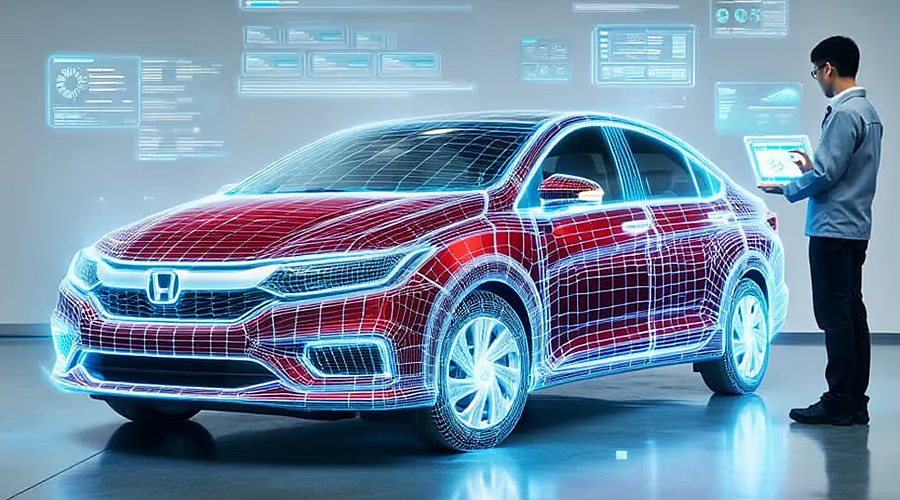
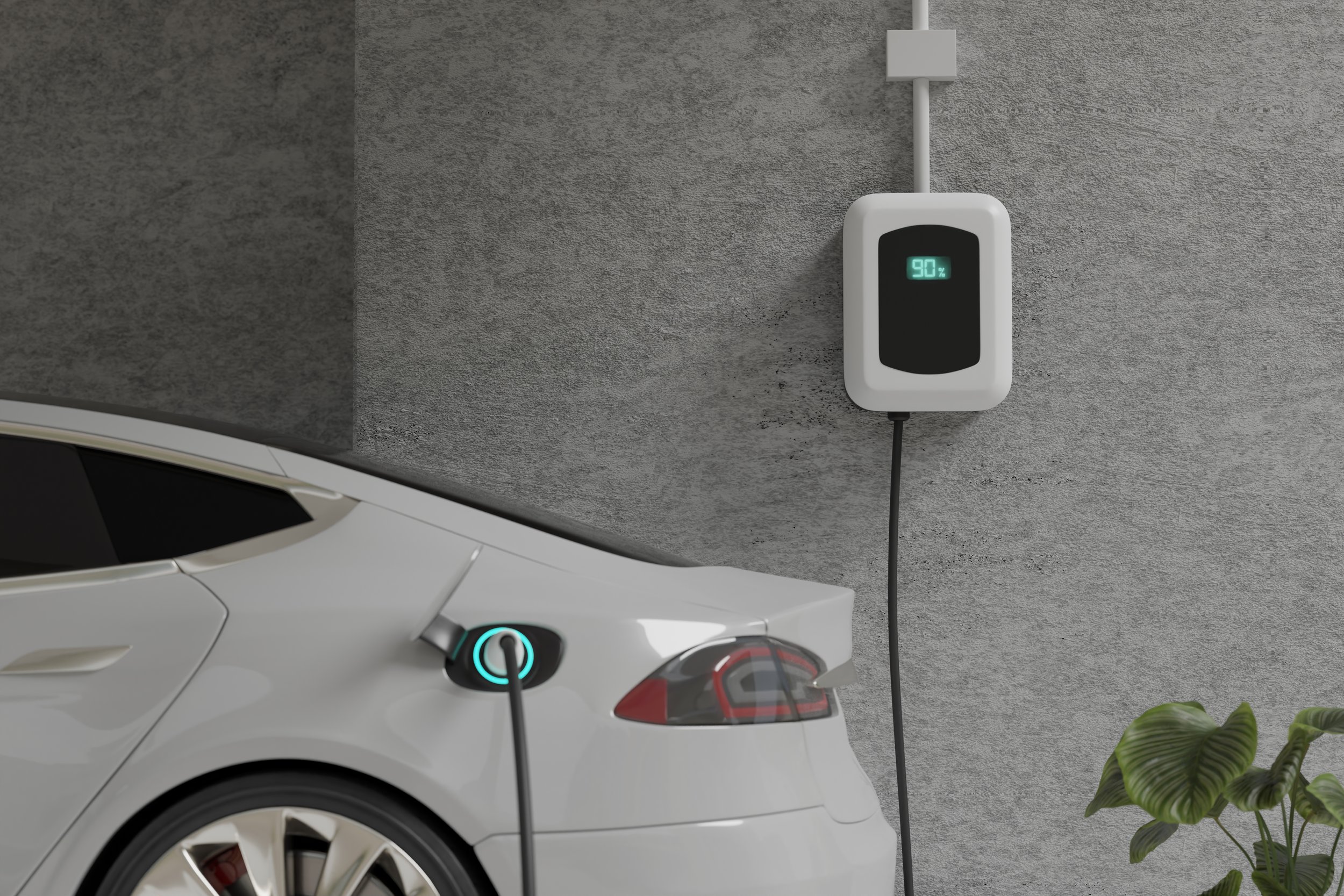
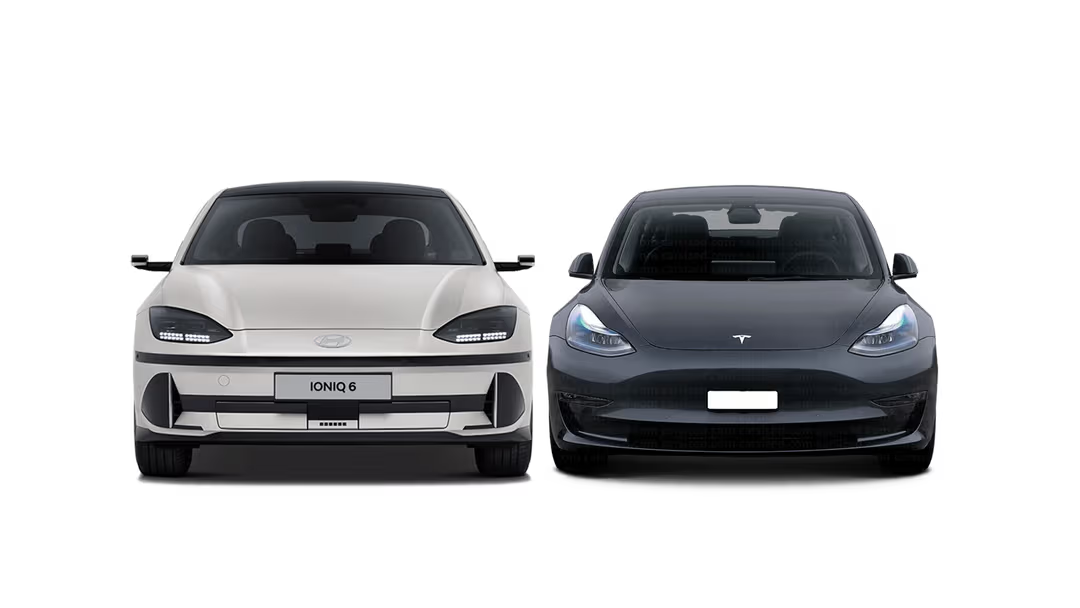

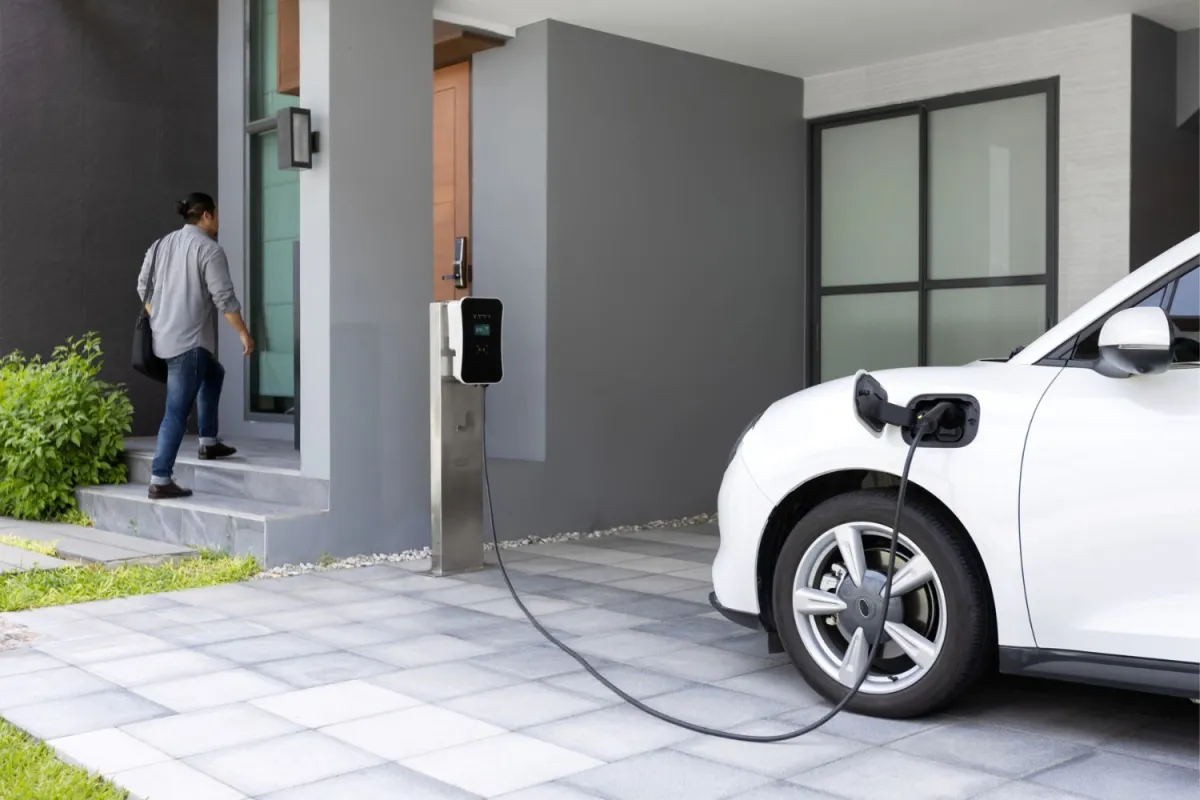


Tags
📧 Get More Articles Like This
Subscribe to receive product reviews and buying guides in your inbox!
We respect your privacy. Unsubscribe at any time.